

Today, having described the playable races, I’ll talk about how you can specifically and elaborately customise your character.
Let’s start with the standard, facial customisation.
Facial Customisation
Humans (see above) can choose widely from the sort of options we see frequently in other games. Numerous hairstyles and beards. Face paint. Jewelery. Features that can be warped and tweaked. Practically speaking, the humans who enter through the gates are nearly always men, but occasionally a woman will somehow beat the sytem, so to speak. When this happens, it’s usually because she was mistaken for a man by whatever it is that judges these things (there are vague explanations in the local mythology, but nobody really knows how this works).

Gate people are always hairless, but they sometimes wear protective headscarves, and women (and occasionally men) who have been raised as concubines often wear elaborate wigs or headdresses. Creating one of the gate people, you can choose facial markings and colouring, and the proportions of their features. As well, to some extent you can also customise the colour and outline of their ghost – the incorporeal second-self that is the basis of their magic.
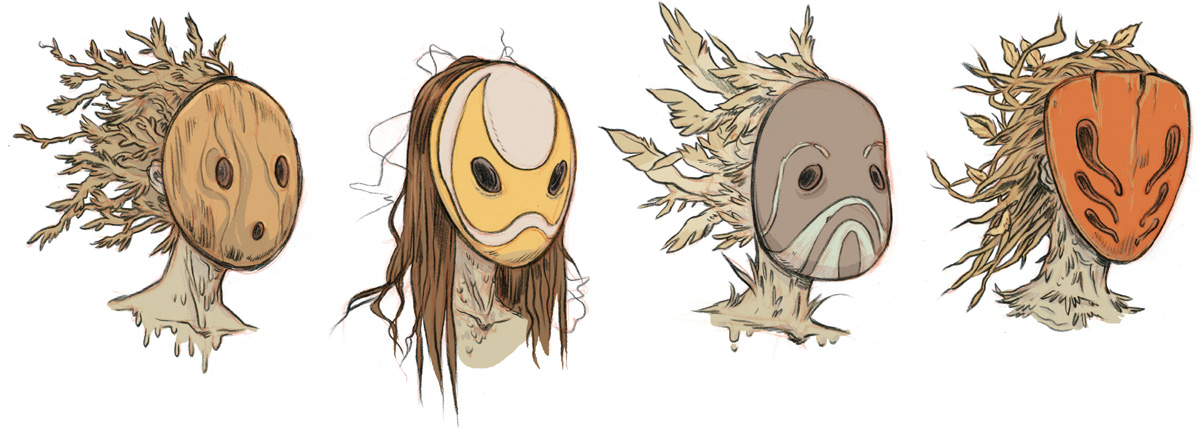
Creating a simulacrum, you can choose the natural materials from which they are made – what sort of dried plants or swamp matter they wear as their hair, what sort of animal parts they are formed from, and whether fur, or scales or feathers are sticking out of (and shedding from) their muddy bodies. And of course, you can design their mask. The face under their mask is blank to start with, and how it forms and alters over time up to you. Every simulacrum must also have something alive inside of it, to act as a beating heart to keep it animate. It could be a bird, a frog, a mouse, a turtle, etc – an animal small enough to fit inside its chest – and you can choose this as well.
Body Customisation

In The Crossing there is full body customisation. You can choose how tall or short you are. You can choose how fat or thin you are. You can alter the distribution of weight – whether your character is heavy on the top, in the middle, on the bottom, or any combination of all three. Separately, you can also choose how muscular your character’s body is (though this would not affect your strength in-game), so you could be visibly very muscular under your bulk, or be lanky and soft-limbed. Note, though, that only humans and gate people have a musculature, so Simulacra can choose their size and proportions, but not how brawny they are.
Being able to choose the body size of your character in a videogame seems enormously important to me. Of course, I understand why it is extremely difficult to implement. Resources have limits, and morphing armour meshes around a wide variety of bodies must be a nightmare for developers (and no doubt that’s the tip of the iceberg). Still, we are getting to a point in videogame development where we can begin to think about this as being a future requisite. As videogames evolve – as they become increasingly widespread throughout popular culture, and increasingly naturalistic-looking – this kind of diversity becomes more and more crucial.
When I played Final Fantasy XIV last year, one of the features I was most looking forward to was the promised body customisation. My expectations were realistic, I thought. There might be a height-slider, and a bust-slider, and a hip slider. Still, if I could make a tall, flat-chested, moderately wide-hipped lady, then I was prepared to be well-pleased.
The feature did not end up being in the game, however. If there were differences in the body-types available, they were so minor that they might as well have not been there. In fact, it was impossible to make an unusual-looking, or not-conventionally-attractive character, in that game. All of the noses, eyes and mouths were nearly identical. You may have felt like you were making decisions about your appearance, but they hardly made any difference in the end. Everyone looked the same.
It begins to feel a little creepy, exploring an enormous open world where everyone has exactly the same body. And it comes a little too close to the sort of body perfectionism that we’re preoccupied with as a culture – the notion that all of us should want to have bodies that fit within the narrow (and narrowing) range of what is considered acceptable. This should be worrying and unpleasant even for people who more or less resemble the characters who represent us in videogames, because it effects everybody.
I referenced Mass Effect, yesterday. In future games like this, I hope it’s not just possible to save the universe as a woman wielding the same aggressive and un self-conscious body language as a male character. I hope it can be done as a fat man or woman, too, or any in-between along the way. As any ethnicity or gender identity.
Tomorrow, I’ll talk about some of the play mechanics – the crafting systems, and the weapons and armour. I’ll give you a break from the political stuff. Actually, no… wait, I can already think about how armour models are political… well, nevermind that.
Leave a Reply